

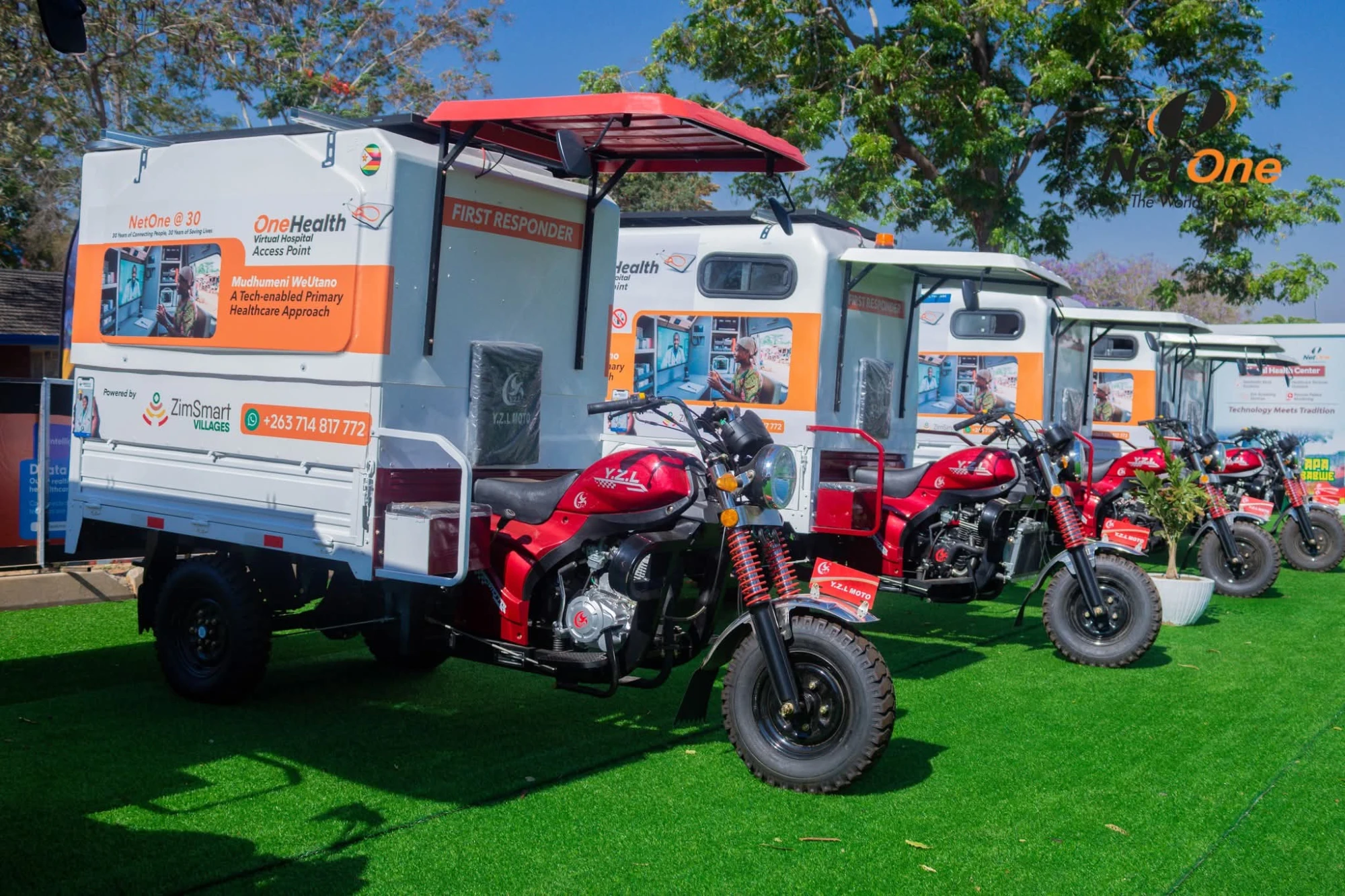
NetOne has moved its telehealth programme from fixed community sites towards a national mobile rollout, funding 10 three-wheeler health kiosks as the first phase of a plan that could eventually grow to 100 units.
The initial fleet was launched in Chinhoyi on 17 October during the 23rd ZANU PF People’s National Conference. One unit has been allocated to each of Zimbabwe’s 10 provinces, according to reports from The Herald and TechnoMag. The wider 100-kiosk figure is a rollout target, not the number of units currently operating.
That distinction matters. The first 10 kiosks now have to show whether a small mobile clinic, connectivity and a link to remote clinicians can become a dependable part of rural primary healthcare rather than remain a promising launch-day demonstration.
What the mobile kiosks are designed to do
The kiosks are built on three-wheeler vehicles that can move between communities. Reports from the launch describe the units as solar-powered and Starlink-connected, although NetOne has not yet published a detailed technical specification or operating plan for each province.
The service model is intended to begin with a nurse and community health worker. They would identify health concerns, carry out approved checks, provide health information and connect eligible patients to a clinician through telehealth. Patients who need care beyond the kiosk’s scope would be referred to an established health facility.
Planned services include blood-pressure and blood-glucose screening, maternal and child health support, malaria services, HIV and tuberculosis support, and early identification of some cancers and substance-abuse problems. What can actually be offered at a particular stop will depend on approved clinical protocols, trained staff, supplies and a working referral pathway.
NetOne is funding and supporting the programme through its OneHealth initiative. ZimSmart Villages is providing the digital-health and operational framework, while the ZANU PF Department of Health is described as leading the initiative.
This is an expansion, not NetOne’s first telehealth experiment
The mobile fleet builds on several fixed telehealth sites already associated with NetOne and ZimSmart Villages. Projects have previously been reported in places including Mhangura, Ntunungwe in Bulilima and Gokwe-Nembudziya.
STACKWIRE’s earlier report on the Mhangura kiosk noted the potential to reduce travel for an initial consultation, but also highlighted missing public detail about staffing, operating hours, available services, privacy and referral procedures.
The latest announcement is therefore not simply another kiosk opening. It is an attempt to turn a collection of local telehealth projects into a repeatable mobile model. The first unit in every province gives the partners a chance to test the same operating system across communities with different geography, network coverage and access to nearby clinics.
The first 10 need measurable targets
A nationwide allocation sounds broad, but one mobile kiosk per province can only cover a small share of the population. The value of this phase will come from what the partners learn and publish.
The first unanswered question is location. NetOne and its partners have not published a province-by-province schedule showing where each kiosk will start, which wards it will visit, how often it will return or how residents will know when it is available.
The second is staffing. A nurse and community health worker are central to the proposed model, but the public reporting does not explain who employs them, whether they travel with one unit full-time, how absences are covered or which clinicians are available for remote consultations.
The third is referral and follow-up. Screening only creates value when a person who needs treatment reaches the right facility and remains in care. The programme will need clear agreements with local clinics and hospitals, a safe way to share patient information and a process for following up after the kiosk has moved elsewhere.
Connectivity is another dependency. Satellite access can help in areas without reliable terrestrial broadband, while solar power can reduce dependence on the grid. Neither removes the need for equipment maintenance, data protection, consumables and technical support when a unit fails in the field.
What success should look like
The partners have not announced when the remaining 90 kiosks will be funded or deployed. Before that expansion, the first phase should produce evidence that can be examined beyond headline launch numbers.
Useful measures would include the number of communities visited, patients screened, successful clinician connections, referrals completed, follow-up visits and equipment downtime. The programme should also report the average cost per consultation and whether patients saved meaningful travel time and money.
Patient experience will matter alongside volume. Rural residents should be able to understand who sees their information, where records are stored, what happens if the connection fails and whether using the service carries any fee. Telehealth conducted in a compact mobile unit also needs enough privacy for sensitive consultations.
If those safeguards and operating details are built into the first 10 kiosks, the model could extend the reach of clinics and clinicians without pretending to replace them. A mobile unit can screen, connect and guide a patient, but emergencies, physical examinations, laboratory work and treatment still depend on the wider health system.
The rollout starts with proof, not promises
NetOne’s contribution gives the project vehicles and connectivity, while ZimSmart Villages brings experience from earlier telehealth sites. That is a credible base for a pilot spanning all provinces.
The harder work begins after the launch. The programme must keep each kiosk staffed, supplied, connected and tied to facilities that can accept referrals. It must also show communities where and when the service will appear.
For now, Zimbabwe has 10 mobile health kiosks in the first phase of a proposed 100-unit rollout. Whether the other 90 should follow will depend on transparent results from these first vehicles and on whether rural patients experience them as reliable healthcare access, not occasional technology exhibitions.




Discussion
0 Comments
No approved comments yet. Start the conversation.