

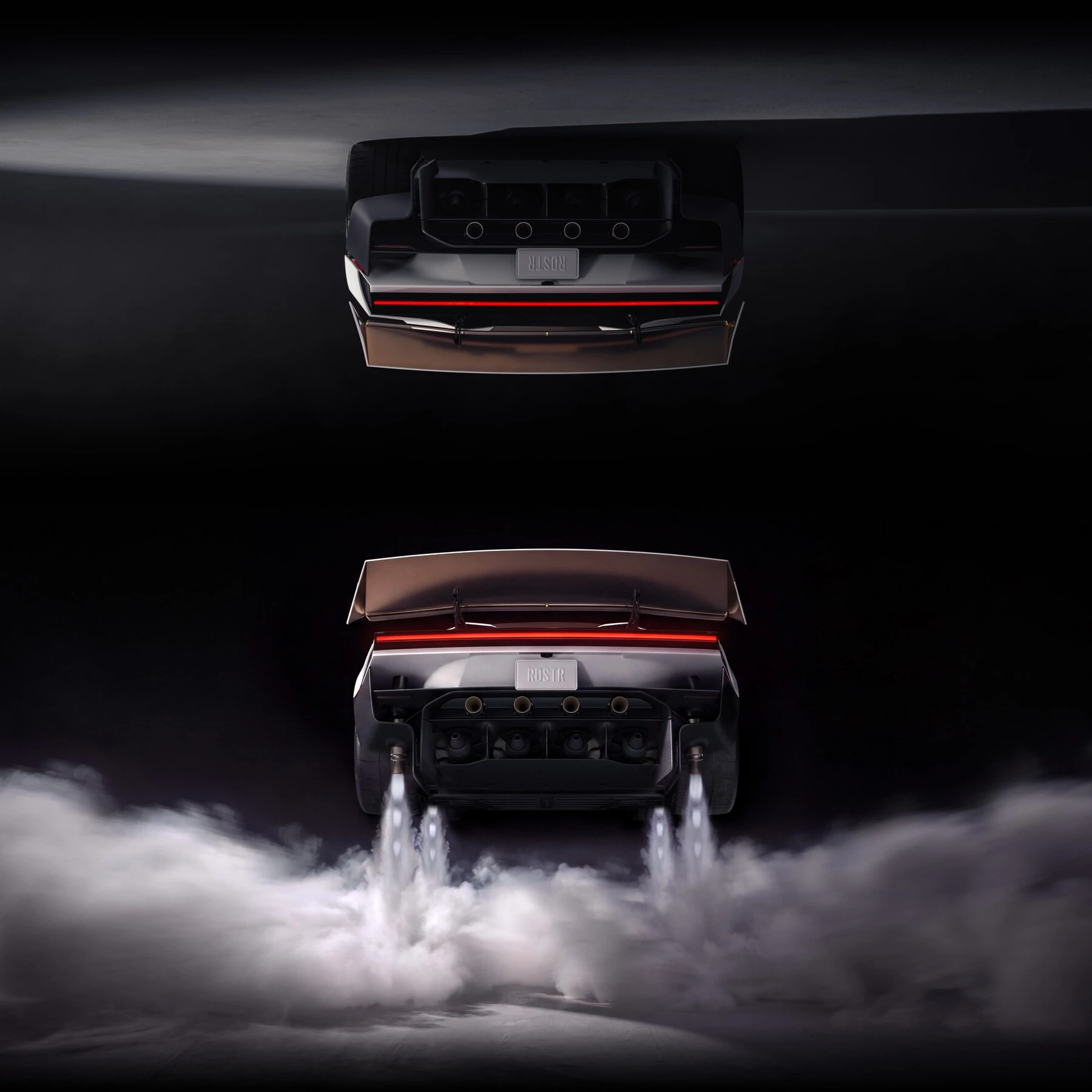
Tesla has finally shown the second-generation Roadster doing something no production car has been designed to do: launch into the air, rotate, and land under its own control.
At a 15 October event near Waco, Texas, the electric-car maker demonstrated a redesigned Roadster prototype using high-powered suction fans and compressed-gas thrusters. The car drove up an inverted ramp, held itself upside down, spun toward the ground and landed. In a separate run, it jumped over a line-up including the Model 3, Model Y, Cybertruck, Cybercab and Tesla Semi while rolling in the air.
The spectacle is being described as a flying Tesla or a car that can backflip. Both capture the drama, but neither tells the full story. This was a controlled prototype demonstration, and the most extreme configuration is not approved for public roads.
How the Roadster pulls off the stunt
The new Roadster combines two systems that attack the normal limits of a car in different ways.
The first is a fan-powered suction system. It removes air from beneath the car to create a low-pressure area, pulling the Roadster toward the surface below it. Unlike a conventional wing, which needs airflow and speed to generate downforce, a fan system can produce grip while the vehicle is moving slowly or standing still. That is how the prototype remained attached to the steep and inverted sections of the ramp.
The second system was developed with SpaceX engineers. Ten nozzles use compressed gas stored in carbon-fibre overwrapped pressure vessels positioned through the vehicle. Firing them in different directions adds straight-line thrust or rotational force. Tesla engineering vice-president Lars Moravy said the system carries about 600 litres of compressed air and can replenish the tank.
These are cold-gas thrusters, not miniature combustion rockets. They release stored pressurised gas to create force. That makes them simpler than a rocket engine, although packaging high-pressure vessels inside a passenger vehicle creates safety, weight and regulatory questions.
Tesla also used rear-facing thrusters to push beyond the traction limit of the tyres. A timer shown during the presentation recorded a 0-to-60 mph run of 0.81 seconds. That remains a manufacturer demonstration rather than an independently verified production-car test.
Three versions, only one built for flips
The two-seat Performance model is described as road ready, with active aerodynamics and the multi-mode suction system. The limited-release Thrust version adds rear-mounted cold-gas thrusters and is positioned as a race-focused car. The single-seat Rocket version adds thrusters around the car for vertical and rotational movement.
It is the Rocket version that performs the aerial tricks. Tesla’s own Roadster page carries an important qualification: Rocket is invite-only and not approved for public-road use. Buyers should not expect to backflip over traffic or use the system as an everyday shortcut.
Tesla says range will exceed 300 miles and lists a top speed above 230 mph, depending on configuration. Reservations have reopened, but final purchase prices have not been disclosed. Elon Musk said production is planned for 2028.
A different Roadster from the 2017 promise
Tesla first revealed the second-generation Roadster in 2017 and targeted production for 2020. It promised four seats, 620 miles of range and acceleration to 60 mph in 1.9 seconds. Multiple delays followed as Tesla concentrated on the Model 3, Model Y, Cybertruck and other programmes.
The 2026 design is more angular and connected to the Cybertruck and Cybercab design language. It also appears to have traded everyday usefulness and range for more ambitious performance hardware. The new line-up seats no more than two people, while Rocket has one seat.
The flip demonstration therefore resets what the Roadster is meant to be. Rather than a practical electric grand tourer, it has become a showcase for active aerodynamics, extreme downforce, high-pressure gas storage and software-controlled thrust.
The engineering is real; the product questions are too
Fan-generated downforce and cold-gas propulsion are established ideas. What is unusual is Tesla’s attempt to package both into one electric supercar and control them well enough to perform repeatable aerial manoeuvres.
There may be useful lessons beneath the theatrics. Active suction could improve braking and cornering without relying entirely on speed-dependent wings. Precisely controlled thrust could demonstrate new approaches to vehicle dynamics, even if the flip never becomes a normal customer feature.
But a successful stage demonstration is not serial production. Tesla still needs to explain how the system manages heat, noise, tank replenishment, repeated use, crash protection and maintenance. Regulators and insurers will have questions about compressed-gas hardware powerful enough to lift and rotate a car.
The timeline deserves scrutiny too. The Roadster has been delayed repeatedly since 2017, and a 2028 target leaves another two years for specifications, pricing and availability to change.
A halo car, not Tesla’s next mass-market hit
The Roadster is unlikely to transform Tesla’s sales. A low-volume supercar with specialist hardware will not answer demand for fresher, affordable models. Its job is different: to make Tesla look daring again and give engineers a platform where practicality is not the only priority.
On that measure, the reveal worked. A car driving upside down and flipping through the air is instantly memorable. The harder test begins after the applause: turning that prototype into a vehicle customers can buy, operate and trust.
For now, Tesla has proved that its new Roadster can perform a backflip under controlled conditions. It has not proved that the Roadster, or its most spectacular hardware, will reach customers on schedule.


Discussion
0 Comments
No approved comments yet. Start the conversation.