
Zimbabwe’s history is scattered across newspaper archives, government files, academic papers, books, family collections and websites that can disappear without warning. ProfileWiki is trying to place a more accessible layer over that fragmented record.
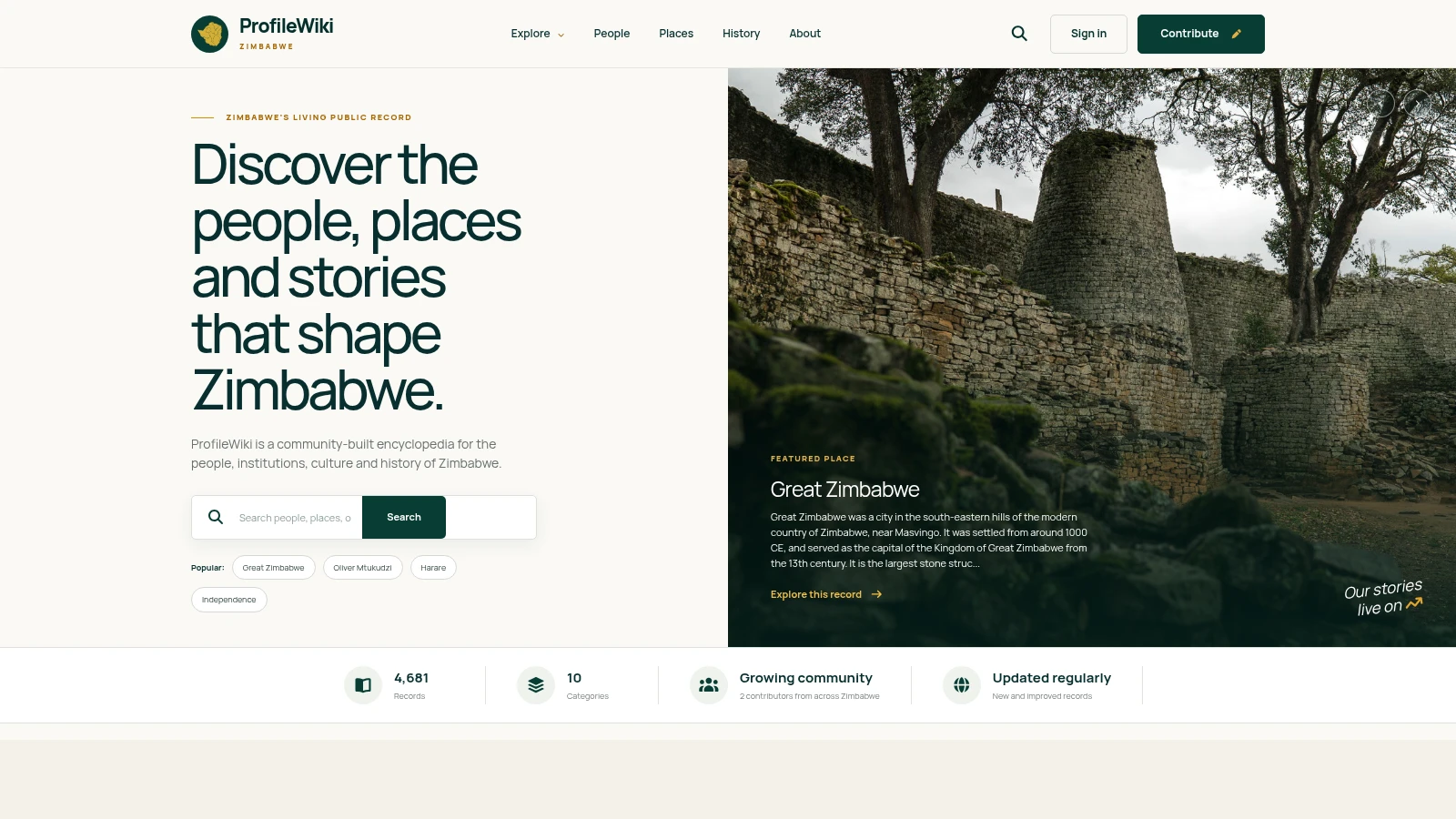
Available at Profile.co.zw, the platform describes itself as a free, community-written encyclopedia for Zimbabwe’s people, institutions, culture and history. Its homepage currently displays more than 4,600 records organised across 10 broad categories, covering subjects ranging from heritage sites and public institutions to artists, political figures, businesses and historical events.
The project matters because discoverability is part of preservation. A record can technically exist and still be practically absent if it is locked in a filing cabinet, buried inside an old PDF or spread between disconnected websites. By giving Zimbabwean subjects dedicated pages, categories, search tools and revision histories, ProfileWiki is attempting to make locally relevant information easier to find, cite and improve.
A Zimbabwe-focused knowledge layer
ProfileWiki resembles a general online encyclopedia, but its scope is deliberately national. The archive is organised around categories including People and Culture, Heritage and Places, Government and Public Life, Events and Movements, Education and Research, Business and Entrepreneurship, and Technology and Innovation.
That focus creates room for subjects that may receive limited attention on global platforms. A Zimbabwean school, sculptor, district, football club or community institution may be locally significant even when editors elsewhere do not prioritise it. Bringing such records into one searchable system can help students, journalists, researchers and members of the diaspora establish context without beginning every search from scratch.
The platform also makes records usable in several ways. Individual pages can include structured facts, citations and categories, while tools for short links, QR codes, printing and PDF output help move a digital entry into classrooms, research notes and physical displays. Search filters separate people, companies, organisations, places, events and general topics.
ProfileWiki’s public activity log shows that a significant part of its initial collection was imported from MediaWiki. That gives the platform a large starting corpus, but it also means its deeper value will not be measured by page count alone. The test is whether Zimbabwean contributors can correct imported material, fill gaps, add local sources and create records that would otherwise remain undocumented.
How contributions become public records
ProfileWiki uses a layered contribution and moderation system rather than allowing every visitor to alter a public page immediately.
Registered members can suggest edits, request missing pages and join discussions. Contributors with an established trust record can prepare full drafts and upload media. Moderators review submissions and disputes, while administrators manage roles, categories, verification and other platform controls. The site says proposed changes are checked for accuracy, neutrality, notability and source quality before publication.
Its editorial guidelines require significant coverage in reliable, independent sources before a subject is considered notable. They call for at least two independent sources, distinguish reporting and official records from promotional material, and apply stricter sourcing requirements to biographies of living people.
Those rules are important for a national reference platform. A public archive that accepts unchecked biographies can quickly become a reputation-management directory or a collection of copied claims. ProfileWiki’s moderation queue, talk pages, error reports and visible revision histories provide mechanisms for challenging information and seeing how a page has changed.
The platform’s privacy policy says public contributions are retained in revision history even after later edits, preserving an editorial audit trail. Contributors are attributed by username, while deleted accounts can be anonymised. Verification documents are treated differently and, according to the policy, are deleted within 30 days after a decision.
Why local context changes the record
Localisation is not simply replacing foreign examples with Zimbabwean ones. It affects which subjects are documented, which sources are recognised and which details are considered important.
Zimbabwean history is shaped by place names that have changed, institutions that span colonial and post-independence periods, local-language terms, oral traditions and public records that may not be well indexed online. A locally focused editorial community is better positioned to recognise those relationships and to notice when a globally circulated account leaves out important context.
This also creates a path for smaller local publications, academic theses, institutional histories and government documents to become visible through citations. ProfileWiki does not preserve the original newspaper, book or government file merely by linking to it, but a referenced encyclopedia entry can connect readers to sources they would not otherwise know existed.
The need extends beyond one platform. Research published in the ESARBICA Journal found serious constraints affecting long-term digital-record preservation in Zimbabwe, including infrastructure, skills, policy and funding limitations. Zimbabwe’s National Archives has since published a public-sector digital records management framework, reflecting the broader shift from paper processes to electronic records.
ProfileWiki operates in a different lane from that official work. The National Archives is responsible for archival records and institutional preservation. ProfileWiki is a public knowledge and discovery platform: it summarises subjects, organises references and invites communities to improve the account around them. The two functions can complement each other, but they should not be confused.
The preservation questions still to answer
A website becomes a durable archive only when its content can survive technical failure, funding changes and the departure of its original operators.
ProfileWiki publicly explains its editorial process and privacy practices, but key preservation details are not prominent. Readers are not shown a public backup policy, an institutional succession plan or a downloadable archive of the full public collection. The platform’s ownership and long-term governance are also not clearly identified on its public information pages.
Licensing deserves similar clarity. Imported and community-written material needs explicit terms explaining how text and media may be reused, mirrored or preserved elsewhere. Open licensing can help a public knowledge project survive because libraries, researchers and other platforms can legally retain copies with attribution. Without clear reuse terms, access may be free while preservation remains dependent on one operator.
Participation is the other challenge. When STACKWIRE reviewed the platform, its homepage described a growing community but displayed only two contributors. That figure may not capture moderators, administrators or all historical editors, yet it shows how early the community-building effort remains. Thousands of imported records are much easier to accumulate than they are to verify and maintain.
The archive would become stronger through partnerships with universities, libraries, museums, professional associations, newsrooms and local historians. Such institutions can contribute expertise, identify reliable sources and help establish processes for preserving copies beyond the production server.
Preservation as an ongoing public process
ProfileWiki’s most promising idea is that Zimbabwe’s public record should not be treated as a finished book. New research appears, institutions change, errors are discovered and people outside traditional publishing centres hold knowledge that deserves documentation.
A revision history turns that process into something readers can inspect. Moderation reduces the risk that openness becomes vandalism. A Zimbabwe-specific scope gives neglected local subjects a clearer route into the searchable web.
But preserving national memory requires more than keeping pages online. It requires reliable citations, broad participation, transparent governance, portable data, backups and explicit reuse rights. ProfileWiki has built the visible foundation: a polished searchable platform, a growing body of records and rules for community editing.
Its next stage is to show that the archive can become both more locally original and more institutionally durable. If it succeeds, Profile.co.zw will not replace Zimbabwe’s libraries or archives. It can do something complementary and valuable: help Zimbabweans find, connect and continuously improve the public story those institutions preserve.



Discussion
0 Comments
No approved comments yet. Start the conversation.